1080 baiting warnings should not depend on postcode.
The 1080 Watch Map shows what becomes possible when agencies publish usable baiting information. But a detailed alert for one program does not mean all government-authorised 1080 operations are disclosed. We are asking every state and territory to make clear, accessible and lasting public warnings available across relevant programs — so people can understand where and when 1080 may be used.
Pre-written message. Takes about 2 minutes.
NPWS publishes detailed alerts and Local Land Services publishes some program notices. Comparable coverage across all relevant government programs has not been established.
DBCA maps Western Shield 1080 poison risk areas, but states that other 1080 baiting can occur and is not shown on those maps.
Published warnings differ by agency, program and jurisdiction. Detailed examples cannot establish that every relevant operation is publicly disclosed.
The tracker shows published warnings — not every operation.
NSW NPWS publishes detailed site-level alerts and Local Land Services also publishes some operation notices, but comprehensive cross-government coverage has not been demonstrated. WA maps Western Shield risk areas while identifying other baiting outside that coverage. Victoria publishes program-specific maps and Parks Victoria notices; Queensland publishes selected detailed alerts, while the ACT has standing area warnings. These sources show what good disclosure can look like, but not the full extent of government-authorised 1080 activity.
The campaign calls for one minimum public warning and disclosure standard across relevant government-undertaken, funded, commissioned, authorised and administered programs — including those delivered by contractors. The public should not need to know which agency or program to search before finding a warning.
Ask governments to adopt one consistent 1080 public warning standard.
Send a ready-to-edit national message asking for clear, searchable, current and preserved public information about 1080 baiting across Australia.
No pin does not mean no 1080 baiting.
The tracker reflects identifiable public sources, not every 1080 program. An empty area on the map is not evidence that no baiting occurs there; a notice not found in our review is not proof that none was ever published.
View the disclosure standardAdopt a minimum 1080 public warning and disclosure standard.
Australia has national chemical controls for 1080 poison, while states and territories regulate how 1080 products are used after sale. But that does not guarantee clear public access to warnings. The proposed national public warning and disclosure standard would require consistent, searchable and archived information across relevant government-authorised programs, regardless of agency, delivery partner or land tenure — including location, dates and current status, explicit identification of 1080, baiting method, target species and purpose, responsible authority and contact, a stable public source, preserved history and reusable data. Where precise private-property locations raise legitimate privacy concerns, public records can generalise the location without removing the operation from the public record.
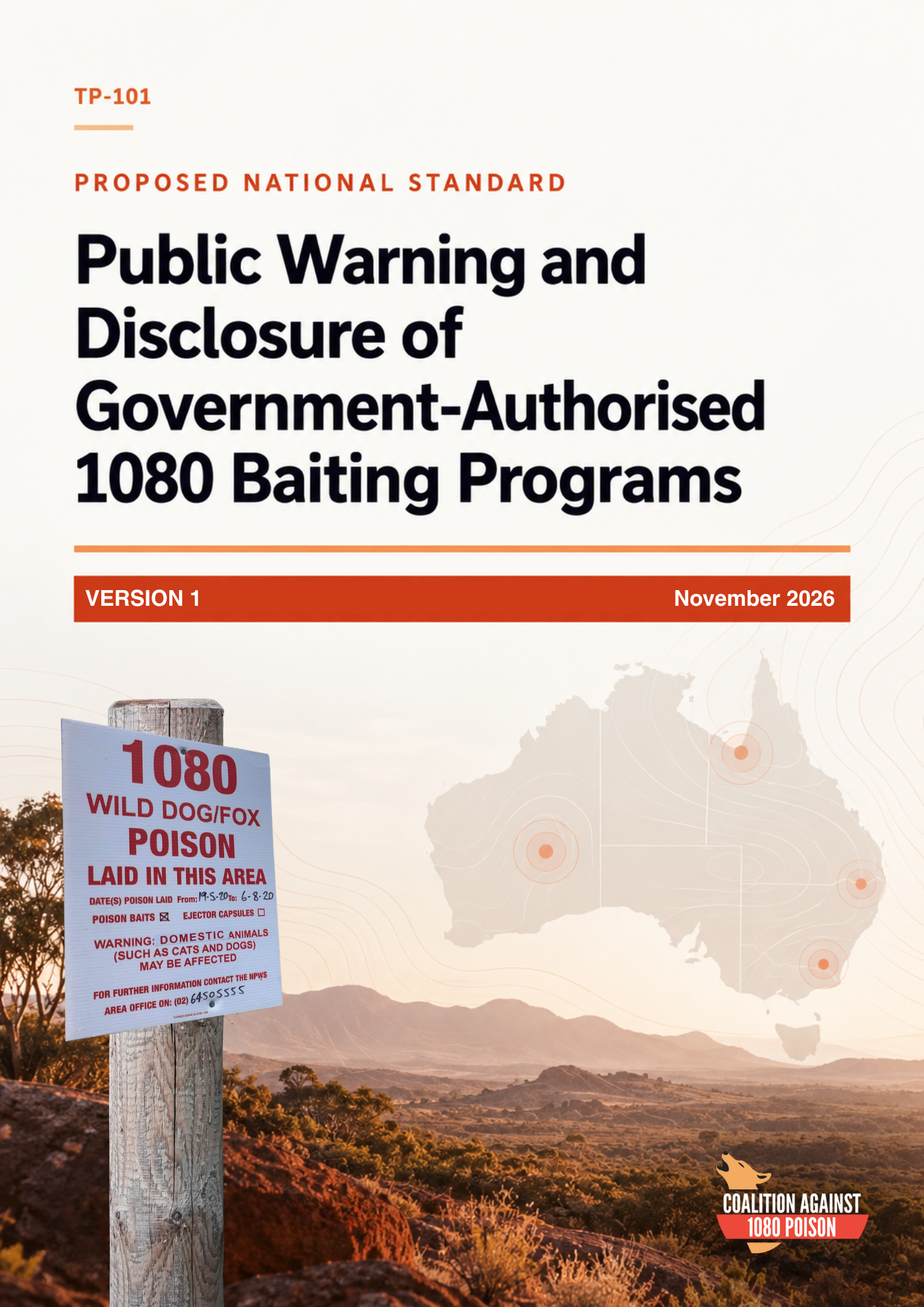
Explore TP-101.
A practical framework for clearer, consistent and lasting public warnings about government-authorised 1080 baiting programs.
What every warning should include
Where
Site names, mapped operational areas or appropriately generalised locations where privacy safeguards are justified.
When
Start and end dates or operational windows, current status and material updates.
What + how
Explicit identification of 1080 and the aerial, ground or other baiting method used.
Why
Listed target species and the official purpose of the program.
Who
Responsible authority or agency and a clear public contact.
Source
Stable public links, preserved current/completed/cancelled history and reusable or downloadable data, ideally including spatial data.
You’ve seen the gap. Ask governments to fix it.
The proposed minimum standard turns the audit findings into a practical reform ask. Send the national message, then explore the jurisdiction findings below.
See what your jurisdiction currently publishes.
Public disclosure varies across Australia. These findings distinguish what individual government sources publish from whether equivalent warnings cover all relevant programs. No jurisdiction has yet demonstrated complete statewide coverage within the evidence reviewed. Explore the source-backed findings below and ask for a consistent national minimum standard.
Support the national public warning and disclosure standard.
The national action asks for a common minimum public warning and disclosure standard while preserving stronger systems that already exist. This is the primary campaign action across the transparency project.
Explore the jurisdiction findings
These are evidence-based, provisional summaries — not grades of whole-of-jurisdiction compliance. Source examples were reviewed in September 2026; the assessment scope was clarified on 16 October 2026. Open a jurisdiction page for further evidence and the specific reform request.
Detailed NPWS notices and some LLS notices; statewide program coverage remains unverified.
NPWS publishes detailed 1080 park alerts; Local Land Services also publishes some specific program notices, including joint operations. The audit has not established equivalent public coverage across relevant NSW agencies, government-authorised programs and land tenures.
Create one searchable NSW public register covering relevant government-undertaken, funded, coordinated and authorised 1080 programs, with mapped areas, dates and status, methods, targets, contacts, stable sources, preserved history and reusable data.
Western Shield is mapped, but that layer does not cover all relevant WA government 1080 programs.
DBCA publishes Western Shield 1080 poison-risk mapping. DBCA also indicates Parks and Wildlife Service baiting may occur beyond Western Shield, so these maps must not be interpreted as complete statewide coverage.
Publish a searchable register across relevant WA government programs, with mapped operational areas, dates and status, methods, targets, contacts, permanent source notices, an archive and reusable spatial data.
Detailed mapped notices exist, but consistent statewide coverage has not been demonstrated.
Agriculture Victoria/DEECA publishes mapped eastern program notifications and Parks Victoria publishes separate notices and archive material. These are substantial public sources, but there is no verified across-program inventory, consolidated historical record or reusable statewide 1080 dataset.
Unify existing mapped records and notices across relevant Victorian government-authorised programs, with consistent fields, responsible agencies and contacts, stable links, searchable history and reusable spatial data.
Generic park-control notices do not reliably establish whether 1080 is being used.
NPWS SA publishes dated animal-control and closure alerts, and PIRSA publishes 1080 regulatory guidance. But generic notices may not identify the toxin, method or target species; the reviewed sources did not establish a searchable 1080-specific current operational register.
Explicitly identify 1080 in each applicable public warning and publish mapped location, timing and status, method, purpose or targets, responsible contact, safety advice, stable source, history and reusable data.
Detailed park and departmental notices exist, but consistent 1080-specific coverage is unverified.
Queensland Parks and departmental notices demonstrate that operational detail can be published. However, some control alerts do not expressly identify 1080; those notices cannot confirm 1080 use, and publication coverage across relevant government programs has not been established.
Require consistent operation-level notices across relevant Queensland government programs that explicitly identify 1080, the affected area, dates and status, method, targets or purpose, responsible contact, source, archive and reusable data.
Permit and regulatory information exists, but a current operation-level public register was not identified.
Tasmanian agencies hold regulatory and permit information about 1080 use, and local notification or signage requirements exist. The reviewed public sources did not establish a current searchable operation-level warning register with verified locations, dates and methods.
Publish current and archived operation-level notices with usable locations, dates and status, confirmed 1080 method and target information, responsible contacts and stable sources, with appropriate private-property privacy safeguards.
Standing area warnings exist, but they are not records of specific current 1080 operations.
ACT public information acknowledges 1080 use, including standing warnings for areas such as Uriarra Forest. The reviewed sources did not identify a complete current operation-level register with confirmed dates, methods and status.
Publish a searchable current and archived register identifying individual operations, mapped locations, dates and status, confirmed toxin and method, targets, responsible contacts, stable source links and reusable data.
Operational records may be collected internally; a current public operation-level register was not identified.
Northern Territory requirements support records of baiting areas, schedules, access points and warning signs. The reviewed evidence did not establish that these operational details are published in a searchable current public register.
Publish searchable current and archived operation-level records with mapped areas, dates and status, toxin and method, targets or purpose, responsible contacts, stable sources and proportionate privacy safeguards.
Keep public warnings public.
The map is free because this information should be public. Keeping it updated, auditing the gap between chemical controls and public transparency, and challenging government disclosure gaps takes work. Choose what this public-interest work is worth to you.